
Custom WooCommerce matrix pricing system for print products
A custom WooCommerce pricing system that replaced complex variable product logic with a flexible matrix-based approach. Built to handle quantity tiers, specification-based pricing, add-ons, and turnaround multipliers with admin-friendly control.
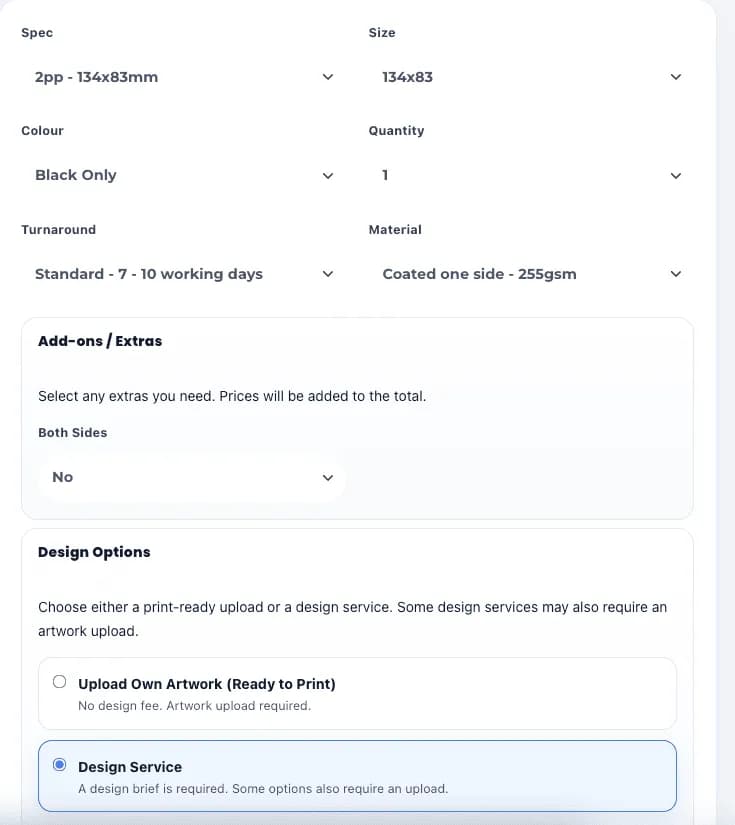
Overview
Challenge
Standard WooCommerce variable product logic became unmanageable for print products with multiple pricing dimensions. The business needed a system that could handle complex pricing rules without requiring constant manual intervention.
Solution
I built a custom matrix pricing system as a WooCommerce plugin. It calculates prices dynamically based on quantity tiers, product specifications, add-ons, design service options, and turnaround multipliers.
Why the existing approach was not working
Variable product complexity
WooCommerce variable products were not designed for the kind of multi-dimensional pricing that print products require. Each combination of size, material, finish, and quantity needed its own variation, creating an unmanageable product structure.
Manual pricing maintenance
Price changes required updating hundreds of variations manually. This was time-consuming, error-prone, and made it difficult to respond quickly to cost changes or run targeted promotions.
Limited add-on flexibility
Express turnaround, design services, and special finishing options needed to integrate seamlessly with the base pricing. The existing plugin ecosystem created conflicts and inconsistent checkout behaviour.
When WooCommerce needs custom development
This project highlighted a common pattern: WooCommerce works well out of the box for standard product types, but businesses with complex pricing requirements often reach the limits of what plugins and extensions can handle. When multiple pricing dimensions interact (quantity × material × finish × turnaround), the variable product system becomes exponentially complex.
The decision to build a custom plugin came down to maintainability. A purpose-built system keeps pricing logic in one place, avoids plugin conflicts, and gives the business direct control over their pricing strategy without requiring developer support for routine changes.
Matrix pricing system architecture
Quantity-based pricing tiers
I structured the system to calculate unit prices based on quantity breakpoints. Larger orders automatically receive appropriate discounts without requiring separate product variations.
Specification-based pricing
Product attributes like size, material, and finish feed into the pricing matrix. Each specification combination maps to a base price that then gets modified by quantity and add-ons.
Add-ons and extras
Design services, special finishes, and packaging options integrate cleanly with the base pricing. Each add-on can have its own pricing logic, including flat fees or percentage-based charges.
Turnaround multipliers
Express delivery options apply multipliers to the base price. The system handles rush orders, standard turnaround, and extended timelines with appropriate pricing adjustments.
System design and implementation
Custom WooCommerce plugin
I built the pricing engine as a custom WooCommerce plugin to keep the logic isolated and maintainable. This approach avoids conflicts with theme updates and third-party plugins while giving full control over the pricing calculation flow.
Admin-friendly pricing control
The admin interface lets non-technical users manage pricing matrices without touching code. Price tables, quantity breakpoints, and add-on configurations are all editable through the WordPress admin.
Front-end pricing experience
Product pages display dynamic pricing that updates as customers select options. The cart and checkout flow shows clear pricing breakdowns, avoiding confusion about what charges apply.
Implementation workflow
Development started with a staging environment that mirrored the production WooCommerce setup. This allowed me to test pricing calculations against real product data without affecting the live store.
The plugin hooks into WooCommerce's pricing filters at the cart calculation level, ensuring that matrix prices override standard variation pricing consistently. This approach maintains compatibility with WooCommerce's core order and checkout systems.
Testing covered edge cases like overlapping quantity tiers, conflicting add-on rules, and cart modifications. The system needed to recalculate correctly when quantities changed, when items were removed, or when coupon codes applied.
Technical considerations
The pricing matrix is stored as structured post meta, keeping it within WordPress's data model while maintaining query efficiency. For stores with large catalogs, this approach avoids the database bloat that comes from creating thousands of product variations.
Front-end price updates use WooCommerce's built-in variation form handling, extending it with custom AJAX handlers that fetch matrix prices. This keeps the user experience consistent with standard WooCommerce behaviour.
The plugin architecture follows WordPress coding standards with clear separation between the pricing calculation logic, admin interface, and front-end display. This makes future maintenance and extension straightforward.
Business value delivered
Replaced complex variable product logic
The matrix system eliminated the need for hundreds of product variations. Product management became straightforward, and the catalog structure is now maintainable long-term.
Clearer admin control
Pricing changes that previously took hours now take minutes. The business has direct control over pricing strategy without needing developer support for routine updates.
More maintainable system
The custom plugin architecture keeps pricing logic separate from theme and other plugins. This reduces technical debt and makes future enhancements easier to implement.
Building custom WooCommerce systems
This project demonstrates when custom plugin development becomes the right choice. Off-the-shelf plugins work well for common requirements, but businesses with unique operational needs often benefit from purpose-built solutions.
The key is understanding where WooCommerce's core architecture can be extended versus where it needs to be worked around. Matrix pricing required hooking into the cart calculation flow while maintaining compatibility with checkout, orders, and reporting.
For businesses considering similar work: the investment in custom development pays off when the system eliminates ongoing manual work, reduces errors, and gives you direct control over critical business logic.
Services that align with this work
WooCommerce Development
Custom WooCommerce solutions including plugins, integrations, and complex product configurations.
Custom Plugin Development
WordPress and WooCommerce plugins built to solve specific business requirements.
Ecommerce Development
Full-stack ecommerce solutions from platform selection to custom functionality.